The Gruha Lakshmi Scheme: A Comprehensive Analysis of India’s Landmark Social Welfare and Women Empowerment Initiatives yes
The concept of welfare governance in India has increasingly prioritized gender-targeted resource distribution. Among the most influential strategies to emerge from this shift are the “Gruha Lakshmi” (also spelled Griha Lakshmi) schemes. Rolled out primarily as flagship socio-economic programs by the state governments of Karnataka and Telangana, these initiatives are explicitly designed to dismantle structural gender inequality, improve household financial resilience, and foster grassroots women empowerment.
While bearing the same name, the two states have deployed the Gruha Lakshmi concept differently: Karnataka utilizes an ongoing cash transfer framework to support monthly household management, while Telangana’s iteration historically focuses on targeted housing subsidies for economically marginalized women, alongside its parallel monthly cash transfer counterpart under the Mahalakshmi umbrella.
Context and Philosophy of the Schemes
For decades, development economists have argued that transferring financial resources directly into the hands of women yields superior developmental outcomes compared to general household transfers. Women statistically allocate a higher percentage of their discretionary income toward children’s nutrition, healthcare, education, and essential family survival needs.
Despite their immense contribution to the domestic economy, millions of women across India function as “unpaid homemakers” without autonomous disposable income. This dynamic creates a severe power asymmetry within families, leaving women financially vulnerable and largely excluded from critical household decision-making processes.
The Gruha Lakshmi schemes directly address this imbalance. By statutorily recognizing the woman as the official “Head of the Household” and routing state funds directly to her, the policy transforms her financial status from a dependent relative to an economically empowered decision-maker. The naming itself is deeply symbolic: “Gruha Lakshmi” translates to the “Goddess of Wealth and Prosperity of the Home,” signaling a structural cultural pivot that values and institutionalizes the economic contribution of women.
The Karnataka Gruha Lakshmi Yojana: Monthly Universal Income Support
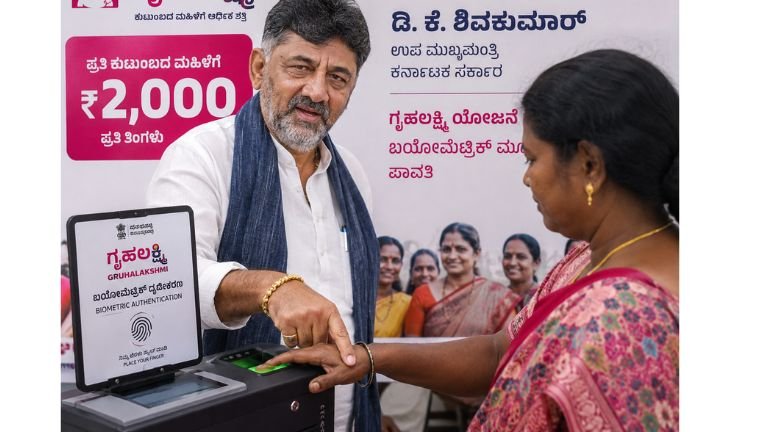
Launched by the Department of Women and Child Development under the Government of Karnataka, this scheme is celebrated as one of the largest direct benefit transfer (DBT) programs for women in the world. It serves as a core pillar of the state’s comprehensive welfare architecture.
+-----------------------------------------------------------------------+
|                    KARNATAKA GRUHA LAKSHMI YOSEMA                     |
+-----------------------------------------------------------------------+
|  Financial Benefit:  ₹2,000 per month                                 |
|  Transfer Mechanism: Direct Benefit Transfer (DBT) via Aadhaar-linked  |
|                      bank accounts                                    |
|  Primary Target:     Women listed as Head of Household on ration cards|
|  Economic Scope:     Covers both BPL (Below Poverty Line) and APL     |
|                      (Above Poverty Line) families                    |
+-----------------------------------------------------------------------+
Core Benefits and Objective
The core objective of the Karnataka model is to mitigate the financial stress induced by inflation and rising living costs. The state provides a guaranteed, permanent monthly financial allowance of ₹2,000 directly to eligible women.
This income is entirely unconditional regarding how it is spent, allowing beneficiaries to allocate funds according to their immediate priorities—whether that involves buying nutritious food, funding a daughter’s higher education, covering monthly electricity and water utilities, handling chronic medical expenses, or building a small savings cushion for emergency scenarios.
Eligibility and Exclusions
To maintain fiscal sustainability while maximizing social reach, the Karnataka government outlines unambiguous parameters for eligibility:
-
Gender and Household Status: The applicant must be a citizen woman and explicitly registered as the “Head of the Household” on the family’s official government-issued ration card.
-
Card Tier Inclusion: The scheme is remarkably inclusive, covering families holding Below Poverty Line (BPL), Above Poverty Line (APL), and Antyodaya Anna Yojana (AAY) ration cards.
-
The Contingency Clause: In the unfortunate event of the registered female head passing away, the scheme allows the family to update their records so the next senior eligible female member can receive the monthly benefit, ensuring the family’s safety net is preserved.
Explicit Exclusion Criteria
To channel resources toward those who genuinely require state-backed financial buffers, the following categories are entirely excluded from receiving the allowance:
-
Taxpaying Households: Households where the female head or her legal spouse files individual Income Tax returns are disqualified.
-
Commercial Compliance: Families where the female head or her spouse is actively registered under the Goods and Services Tax (GST) framework are ineligible.
-
Government Employment: Women or spouses holding active positions in government services, public sector undertakings (PSUs), or those drawing institutional government pensions are barred from applying.
-
Single-Benefit Cap: To maintain systemic equity, only one woman per unique household/ration card is permitted to draw the benefit.
The Telangana Gruha Lakshmi Scheme: Housing and Social Security Infrastructure
In Telangana, the “Gruha Lakshmi” nomenclature has been fundamentally integrated into the state’s housing and infrastructure welfare policies, alongside broader financial safety nets designed to uplift historically oppressed communities.
The Housing Grant Framework
The primary housing-focused Gruha Lakshmi scheme in Telangana addresses a critical dimension of poverty: lack of permanent, safe, and dignified shelter. For families living in substandard structures or temporary setups, the government extends a massive 100% subsidized one-time financial grant of ₹3 Lakhs specifically for constructing a safe, brick-and-mortar (pucca) house.
Unlike standard housing schemes where funds are channeled to contractors or male patriarchs, Telangana’s program mandates that the house must be constructed on a plot owned by or registered to the woman, and the financial assistance is released exclusively in her name.
Phased Financial Disbursements
To prevent fund diversion and guarantee structural completion, the ₹3 Lakh subsidy is strictly disbursed across three distinct, verified stages of construction:
  Stage 1: Basement Completion          --->   Disbursement: ₹1,00,000
  Stage 2: Walls, Doors & Windows Ready --->   Disbursement: ₹1,25,000
  Stage 3: Roof Slab & Final Finishing   --->   Disbursement: ₹75,000
                                               -----------------------
                                               Total Subsidy: ₹3,00,000
Government officials utilize dedicated mobile applications embedded with geo-fencing and time-stamped photography to verify the physical progress of the house before triggering the next automated digital transaction.Targeting Marginalized Groups
The Telangana model places extreme emphasis on intersecting gender with caste-based vulnerabilities. The program prioritizes Dalit women and families already enrolled under targeted empowerment initiatives like the Dalit Bandhu program. It specifically seeks to eliminate homelessness among Scheduled Castes (SCs), Scheduled Tribes (STs), and economically backward Lower Income Groups (LIG).
The Structural Shift: By granting sole ownership rights of real estate assets to women, the scheme effectively counters historical patriarchal property ownership trends, providing women with generational asset security and elevating their socioeconomic standing within their communities. Administrative Mechanics: Registration and Verification Workflows
For social welfare schemes of this magnitude to succeed, administrative transparency and defense against corruption are critical. Both Karnataka and Telangana leverage highly advanced digital public infrastructure (DPI) to deploy, monitor, and scale these programs.
Required Documentation Checklist
To apply through either online portals or physical state assistance centers, applicants must compile a uniform set of foundational identity and socio-economic proofs:
-
Aadhaar Card: Required for both the applicant and her spouse. Crucially, the Aadhaar must be linked to an active mobile number to complete biometric or OTP verification.
-
Valid Ration Card: Serving as the structural baseline to verify household composition and confirm the woman’s designation as the head of the family.
-
Aadhaar-Seeded Bank Passbook: Essential for the deployment of Direct Benefit Transfer (DBT). The bank account must feature an active National Electronic Funds Transfer (NEFT) or Real-Time Gross Settlement (RTGS) protocol mapping.
-
Domicile/Residence Certificate: Documented proof certifying permanent, multi-year residency within the respective state boundaries.
-
Socio-Economic Certificates: Income certificates validating non-taxpayer status, or Caste Certificates (crucial for Telangana’s housing framework) to confirm eligibility under prioritized community quotas.
Multi-Channel Registration Framework
Governments have instituted hybrid delivery systems to eliminate digital exclusion among rural, illiterate, or semi-urban populations:
-
Self-Service Online Portals: Tech-literate citizens can log directly into official state engines—such as Karnataka’s Seva Sindhu portal or Telangana’s centralized e-governance systems—to fill out profiles and upload scanned documents.
-
Assisted Citizen Service Centers: To cater to communities lacking internet access, applications can be processed at designated brick-and-mortar public service centers. In Karnataka, these include Grama One (rural), Karnataka One (semi-urban), Bangalore One (urban), and Bapuji Seva Kendras. In Telangana, applications are integrated into the Praja Palana public outreach frameworks and local Gram Panchayat offices
Economic and Social Impact Metrics
The socio-economic outcomes generated by injecting hundreds of crores of rupees directly into the female rural and suburban economy are profound and multifaceted.
The Multiplier Effect on Local Economies
When cash transfers are delivered to low-and-middle-income women, the money enters circulation almost immediately. Unlike wealth accumulation at the top, these funds drive local consumption.
Beneficiaries spend their monthly ₹2,000 allowance or housing allocations on village markets, local groceries, dairy cooperatives, and small-scale retail shops. This constant influx of capital creates a powerful economic multiplier effect, stimulating rural commercial ecosystems and supporting local jobs.
Enhanced Financial Autonomy and Micro-Savings
For many women, this scheme marks the first time they possess a bank account that isn’t controlled by a spouse or father-in-law. This independent access acts as a primary step toward formal financial inclusion.
Women are no longer entirely dependent on male relatives for small daily expenditures, reducing domestic friction and emotional stress. Furthermore, it encourages the development of micro-savings habits and strengthens participation in local Self-Help Groups (SHGs).
Societal Investment in Human Capital
Data collected from tracking social development metrics reveals that financial assistance earmarked for female heads directly translates into improved health and education metrics for the next generation:
+------------------+     +-------------------+     +--------------------+
| Secure Financial | --> | Better Dietary &  | --> | Lower Malnutrition |
| Cash Infusion    |     | Medical Choices   |     | & Dropout Rates    |
+------------------+     +-------------------+     +--------------------+
With dedicated funds, mothers can afford fresh produce, clean dairy, and vital medical immunizations for their children. It also significantly lowers school dropout rates, as families are no longer forced to pull children—particularly young girls—out of school due to minor, unexpected financial deficits.
Challenges, Structural Bottlenecks, and Solutions
Despite their clear successes, executing large-scale welfare policies across vast, diverse populations presents significant structural challenges.
Banking and Technical Failures in Direct Benefit Transfers
The single greatest operational challenge stems from technical failures within the Direct Benefit Transfer (DBT) pipeline. Millions of women experience delayed or rejected transactions due to discrepancies in data alignment—such as a spelling mismatch between a ration card and an Aadhaar profile.
Furthermore, if a bank account is not correctly mapped to the National Payments Corporation of India (NPCI) mapper, automated state releases fail. To combat this, states have launched door-to-door verification drives using local village administration officers and Anganwadi workers to rectify bank-seeding errors directly at the beneficiary’s home.
Fiscal Sustainability and Budgetary Pressure
Allocating thousands of crores annually to sustain cash transfer programs places massive pressure on state exchequers. Critics frequently argue that spending heavily on direct revenue transfers can divert crucial funding away from long-term capital investments, such as building heavy infrastructure, modernizing public transport, or constructing new hospitals.
Balancing immediate, necessary poverty alleviation with long-term macroeconomic development remains a constant structural challenge for policymakers.
The “Gender Tokenism” Risk
There is an inherent risk of administrative tokenism, where a woman is listed as the household head on paper solely to secure government funds, while actual financial control remains with male relatives.
Overcoming this requires deep socio-cultural transformation. However, long-term studies show that the physical act of a woman visiting a bank, interacting with local officials, and managing a digital account gradually builds the confidence needed to claim real, lasting authority over household finances.
Comparative Framework: Karnataka vs. Telangana
To understand the operational scope of these welfare strategies, it is helpful to contrast how each state executes its program:
| Functional Parameter | Karnataka Model (Gruha Lakshmi) | Telangana Model (Gruha Lakshmi / Housing Context) |
| Primary Core Benefit | Regular monthly cash transfer of ₹2,000 for ongoing expenses. | One-time financial asset creation subsidy of ₹3,000,000. |
| Operational Goal | Immediate poverty mitigation, income stability, and inflation defense. | Eradication of homelessness and creation of fixed real estate assets for women. |
| Target Population | Broadly inclusive (covers BPL, APL, and AAY cardholders). | Highly targeted focus (primarily Dalit women, LIG, and SC/ST communities). |
| Disbursement Strategy | Continuous monthly Direct Benefit Transfers (DBT) directly to bank accounts. | Tranche-based releases tied to verified physical construction milestones. |
| Administrative Node | Department of Women and Child Development. | Telangana Housing Board / State Housing Corporations. |
apply now
Future Outlook
The Gruha Lakshmi schemes represent a fundamental shift in how Indian states approach poverty alleviation and women’s empowerment. By moving away from indirect, trickle-down family benefits and focusing directly on individual women, these programs recognize and value women’s vital role in both the home and the broader economy.
The success of these programs has established a clear blueprint for public policy across the country. As digital identification and banking infrastructure continue to improve, the delivery of these benefits will become increasingly seamless.
While managing the long-term fiscal impact remains a challenge for state planners, the social returns—measured in healthier families, educated children, and empowered, independent women—represent an invaluable investment in India’s future human capital. The Gruha Lakshmi model demonstrates that true economic progress begins by ensuring financial security and dignity at the center of the home.