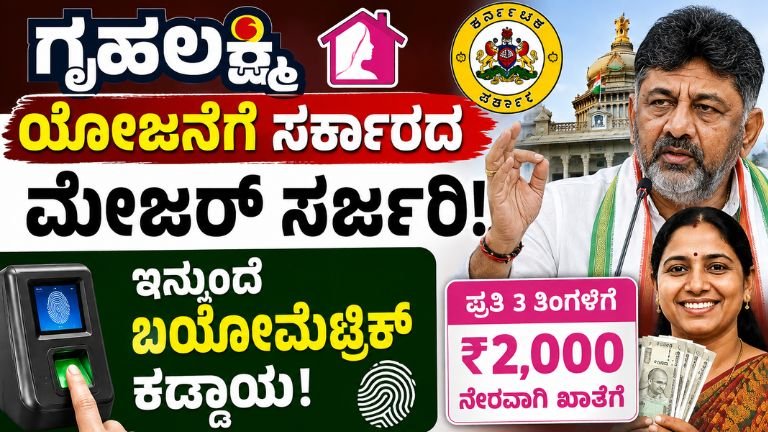
Karnataka Gruha Lakshmi Scheme 2026: Mandatory Biometric Verification to Weed Out Ineligible Beneficiaries g 5
The Congress-led Karnataka state government is executing a major overhaul of its flagship welfare program, the Gruha Lakshmi Scheme. To eliminate systemic leaks, corruption, and fraudulent accounts, the Department of Women and Child Development has introduced a mandatory biometric authentication process for all registered beneficiaries.
According to an investigative report by Asianet Suvarna News, a statewide door-to-door audit conducted by Anganwadi workers exposed thousands of instances where monthly payouts were being deposited into the accounts of deceased individuals, taxpayers, and ineligible applicants. To seal these gaps and ensure fiscal accountability, the government will henceforth release the monthly ₹2,000 cash transfer only after a successful digital identity validation.
Here is a comprehensive breakdown of the new biometric updates, required documentation, regional statistics on irregularities, and how eligible women can complete their verification without losing their monthly benefits.
Technical Overview of the New Mandate
| Scheme Name | Gruha Lakshmi Yojana |
| State | Karnataka |
| Implementing Authority | Department of Women and Child Development |
| Monthly Financial Aid | ₹2,000 (Direct Benefit Transfer – DBT) |
| Current Total Beneficiaries | Over 1.30 Crore (13 Million) Women |
| New Core Rule | Mandatory Biometric / Life Verification (ಜೀವಂತಿಕೆ ದೃಢೀಕರಣ) |
| Primary Media Source | Asianet Suvarna News |
| Verification Locations | Bangalore One, Karnataka One, Grama One, Bapu Seva Kendras, CSCs |
Why Has the Government Ordered a “Major Surgery”?
The Gruha Lakshmi Scheme is one of the pillars of the ruling government’s five electoral guarantees, distributing financial aid to over 13 million female heads of households. However, managing a welfare apparatus of this magnitude without periodic physical audits led to severe systemic vulnerabilities.
A localized audit spearheaded by grassroots Anganwadi workers brought several shocking compliance issues to light. The state exchequer was leaking millions of rupees every month due to administrative oversights, duplicate profiles, and deliberate misrepresentation.
The Breakdown of Irregularities (A Look at the Numbers)
The depth of the scam became apparent when data from specific regions was analyzed. For instance, in the Bengaluru South Taluk alone, an extensive audit resulted in the immediate elimination of 12,790 ineligible beneficiaries from the database.
The physical verifications highlighted four primary areas of leakage:
-
Deceased Beneficiaries (6,624 cases): Thousands of women who had passed away remained active on the digital roster. Their automated Electronic Clearing Service (ECS) transfers continued to hit their bank accounts month after month, which were subsequently withdrawn by family members.
-
Income Tax & GST Payers (4,800 cases): The scheme was strictly designed to provide financial relief to economically vulnerable or lower-middle-class households. Government guidelines explicitly bar families paying Income Tax or Goods and Services Tax (GST) from registering. Despite this, thousands of tax-paying families bypassed the initial filters.
-
Missing Aadhaar Seeding (1,295 cases): These beneficiaries were drawing funds despite failing basic Aadhaar-to-bank account mapping (Aadhaar Seeding), which violates direct benefit transfer protocols.
-
The Kanakapura Anomaly: The audit identified 3,058 deceased beneficiaries in Kanakapura whose accounts were actively receiving state funds. This single region registered one of the highest concentrations of post-death welfare fraud.
Official Action Plan: The Department of Women and Child Development has initiated strict legal procedures to recover every rupee illegally deposited into the bank accounts of deceased or ineligible individuals since the program’s inception.
Understanding the New Biometric Verification Rule
To permanently eradicate these fraudulent accounts, the state government has designed an ironclad digital filter. The Biometric Authentication Rule serves as a mandatory “proof of life” and verification mechanism.
Moving forward, monthly transfers will be paused for any individual who fails to verify their physical identity within the designated timeframe.
How Identity is Validated
The government system will utilize three distinct biometric verification pathways to accommodate different demographic realities:
-
Thumbprint/Fingerprint Scanning: The standard modality using optical scanners connected to the Central Identities Data Repository (CIDR).
-
Iris Scanning (Eye Scan): An alternative system for elderly beneficiaries or manual laborers whose fingerprints have faded or worn out due to age and physical labor.
-
Facial Recognition: Advanced digital photo matching against the Aadhaar database to verify the beneficiary’s current physical status.
Authorized Centers for Biometric Submission
To avoid chaotic crowds at a single point, the government has decentralized the registration process. Beneficiaries can complete their verification process at any of the following state-authorized citizen service centers:
-
Bangalore One: For urban residents living within the Bruhat Bengaluru Mahanagara Palike (BBMP) limits.
-
Karnataka One: Located across major tier-2 and tier-3 cities and municipal corporations.
-
Grama One: Operating at the village panchayat level to assist rural women without requiring them to travel to taluk headquarters.
-
Bapu Seva Kendras: Rural administrative hubs configured to handle local citizen documentation.
-
Common Service Centers (CSCs): Central-government-aligned digital service kiosks spread across every neighborhood.
Step-by-Step Verification Protocol
Beneficiaries must follow a structured procedure at the service centers to ensure their biometric profile links correctly with the welfare portal.
Step 1: Document Assemblage
Before visiting a service center, the female head of the family must collect the following physical documents:
-
Original Aadhaar Card (Must match the name on the bank account).
-
Gruha Lakshmi Acknowledgement/ID Card issued during the initial application phase.
-
Caste Certificate RD Number: This is an absolute requirement for beneficiaries belonging to Scheduled Castes (SC) and Scheduled Tribes (ST). The operator must enter the unique RD number from the official government certificate into the software to validate caste-based data parameters.
Step 2: Data Input and Upgradation
The center operator logs into the secure Gruha Lakshmi administrative portal, brings up the existing application profile, checks for data disparities, and enters the mandatory SC/ST RD numbers if applicable.
Step 3: Biometric Capture
The applicant undergoes a fingerprint, iris, or facial scan. The portal cross-verifies this live data against the Aadhaar database in real-time.
Step 4: System Confirmation and Receipt
Once the biometric data matches the Aadhaar registry, the system generates a completion status form. The next month’s ₹2,000 allowance will be unlocked and credited via DBT only after this portal form is fully submitted and validated.
Ground Reality: Mixed Reactions from Beneficiaries
As reporting from Asianet Suvarna News reveals, this policy adjustment has sparked contrasting opinions among women across Karnataka:
The Positive Perspective
A large segment of genuine beneficiaries has welcomed the move. For these women, the consistent arrival of the ₹2,000 stipend is an invaluable support system for managing household grocery bills, medical expenses, or children’s school fees. They argue that if a quick trip to a local center secures their monthly allowance and stops corrupt elements from stealing public funds, they are fully willing to cooperate with re-registration or biometric scans.
Conversely, a significant portion of working-class women have raised logistical concerns. Rural daily-wage laborers, agricultural workers, and factory employees note that visiting a Grama One or Karnataka One center often forces them to sacrifice a full day’s wages.
Furthermore, frequent server crashes, power outages, and slow internet connectivity at rural kiosks create massive backlogs. Women are often forced to stand in long lines for hours under harsh weather conditions. Many are urging the government to launch a secure, official mobile application using smartphone-based front-camera facial authentication, which would allow them to complete the process from their homes without losing a day of livelihood.
Summary for Beneficiaries
-
Is it optional? No, biometric validation is 100% mandatory to keep receiving funds.
-
What happens if I miss it? Your monthly ₹2,000 payments will be put on hold until verification is completed.
-
Are there any fees? The state government handles processing costs; beneficiaries should not pay service fees to private center operators.
-
Key Document Check: Make sure your Aadhaar is actively linked to your bank account, and carry your unique Gruha Lakshmi ID slip along with your Caste Certificate RD details to the center.