Pradhan Mantri Ujjwala Yojana (PMUY),
The transition from traditional, highly polluting cooking fuels to clean energy is one of the most significant socio-economic transformations in modern developing economies. At the center of this shift in India is the Liquefied Petroleum Gas (LPG) cylinder subsidy system.
For decades, millions of households relied heavily on solid biomass—such as firewood, dried dung cakes, and agricultural residue—for daily cooking. This practice generated severe indoor air pollution, caused catastrophic respiratory diseases among women and children, and contributed to environmental deforestation.
To systematically address these health, gender, and environmental challenges, the Government of India completely overhauled its domestic fuel distribution networks. Through financial architectures like PAHAL (Direct Benefit Transfer for LPG) and targeted welfare frameworks like the Pradhan Mantri Ujjwala Yojana (PMUY), the gas cylinder subsidy system has become a case study in large-scale social engineering.
Historical Evolution of LPG Subsidies in India
Understanding the current landscape of LPG subsidies requires tracing how the delivery mechanism transformed from a universal commodity subsidy to a highly targeted digital welfare payout.
The Universal Subsidy Era (Pre-2013)
Originally, LPG was subsidized globally at the supply level. The central government absorbed a major portion of the landing, processing, and distribution costs, allowing Oil Marketing Companies (OMCs) like Indian Oil Corporation (IOCL), Bharat Petroleum Corporation Limited (BPCL), and Hindustan Petroleum Corporation Limited (HPCL) to sell gas cylinders to all domestic consumers at a uniform, flat, subsidized price.
While simple to execute, this universal administrative mechanism suffered from three fatal flaws:
-
Severe Fiscal Leakage: Because the price difference between commercial LPG and domestic subsidized LPG was massive, a thriving black market emerged. Subsidized cylinders intended for household kitchens were frequently diverted illegally to commercial establishments like hotels, restaurants, and brick kilns.
-
Ghost Accounts: The system was plagued by duplicate and fake gas connections. Individuals held multiple subsidized connections under variations of the same name or at multiple addresses, collecting excess subsidies far beyond their household needs.
-
Regressive Welfare Distribution: Rich and upper-middle-class urban households, who could easily afford market rates, were consuming the lion’s share of subsidized cylinders because they had better access to supply chains. Meanwhile, the poorest rural households remained completely cut off from clean energy.
The Launch of PAHAL (DBTL)
To block these massive fiscal leakages, the government introduced the PAHAL (Pratyaksh Hanstantrit Labh) scheme, also known as the Direct Benefit Transfer for LPG (DBTL) program. Rolled out nationally in 2015, PAHAL shifted the subsidy from the commodity price to the consumer’s bank account.
Under PAHAL, every consumer pays the full market-determined price (the non-subsidized rate) upfront to the gas distributor upon delivery. Once the delivery is digitally verified, the eligible subsidy amount is calculated and transferred directly into the consumer’s Aadhaar-linked bank account via the National Electronic Funds Transfer (NEFT) or Aadhaar Payment Bridge (APB) system. This digital de-duplication instantly eliminated millions of ghost connections and structurally disabled the diversion black market.
+------------------------------------------------------------+
|                  PAHAL (DBTL) Subisdy Flow                 |
+------------------------------------------------------------+
|                                                            |
|  1. Consumer orders and pays FULL market price to dealer   |
|                    │                                       |
|                    ▼                                       |
|  2. Dealer delivers cylinder & updates digital log         |
|                    │                                       |
|                    ▼                                       |
|  3. OMC verifies delivery data automatically               |
|                    │                                       |
|                    ▼                                       |
|  4. Subsidy cleared & wired directly to linked Bank Account|
|                                                            |
+------------------------------------------------------------+
The “Give It Up” Campaign
With the digital pipeline secure, the government launched the “Give It Up” campaign, appealing to affluent citizens to voluntarily renounce their LPG subsidies. Backed by high-profile public messaging, over 10 million middle-class and wealthy Indian families voluntarily gave up their cooking gas subsidies. The fiscal space saved by this campaign was directly repurposed to fund free gas connections for rural, impoverished families under the Ujjwala program.
Pradhan Mantri Ujjwala Yojana (PMUY)
While PAHAL cleaned up the existing consumer base, it did not solve the entry barrier for the poor. A standard LPG connection required a heavy upfront security deposit for the metal cylinder, pressure regulator, and initial installation charges—an expense completely out of reach for a family living below the poverty line.
To bridge this economic gap, the government launched the Pradhan Mantri Ujjwala Yojana (PMUY) in May 2016.
       PMUY EXPANSION & REACH (2016 - 2026)

  120 Mn ───────────────────────────────────────────┐
                                                    │
  100 Mn ─────────────────────────────┐             │ (~10.5 Cr)
                                      │             │
   80 Mn ───────────────┐             │             │
                        │             │             │
   60 Mn ───┐           │             │             │
            │           │             │             │
            │ (8 Cr)    │ (9.6 Cr)    │ (10.3 Cr)   │
            │           │             │             │
   0 Mn ────┴───────────┴─────────────┴─────────────┴──
          PMUY 1.0    PMUY 2.0     July 2025    Mid-2026
          (2016-20)   (2021-24)    (Historic)   (Current)
Core Architecture and Financial Incentives
PMUY targets adult women belonging to economically disadvantaged households (including SC/ST communities, forest dwellers, and Antyodaya Anna Yojana beneficiaries). By putting the gas connection strictly in the name of the woman of the house, the scheme acts as a direct tool for female empowerment and financial inclusion.
The financial breakdown of the standard PMUY structural support includes:
-
Deposit-Free Connection: The Central Government provides a cash assistance of ₹1,600 per connection. This entirely covers the security deposit of the 14.2 kg cylinder (or 5 kg variant), pressure regulator, Suraksha gas hose, and the domestic consumer card booklet.
-
Ujjwala 2.0 & 3.0 Enhancements: Under subsequent expansions (including the latest operational phases running through 2026), the first LPG refill cylinder and a high-quality domestic gas stove (hot plate) are provided completely free of cost at the time of installation.
Current Subsidy Structure and Policy Shifts
The international landscape for energy resources remains highly volatile. Because India imports roughly 60% of its total domestic LPG requirements, local market prices are intrinsically bound to global crude benchmarks and Saudi Aramco contract prices. To insulate the most vulnerable segments from extreme pricing shocks, the government uses a targeted subsidy mechanism.
The Current Targeted Subsidy Framework
As of the current 2025–2026 operational fiscal cycle, the subsidy framework is strictly segmented:
-
PMUY Beneficiaries: Ujjwala connection holders receive a dedicated, targeted subsidy of ₹300 per 14.2 kg cylinder. This means if the market rate of a non-subsidized cylinder floats around ₹950 to ₹1,000, an Ujjwala family effectively pays a net amount of ₹650 to ₹700, with the ₹300 difference routed back as cashback via DBTL.
-
General Consumers: Non-Ujjwala domestic consumers pay the prevailing market rate determined monthly by OMCs, receiving either no subsidy or nominal, localized adjustments depending on regional distribution logistics.
Structural Refinement: The Quota Adjustment
A major policy shift enacted recently in 2026 involves the optimization of subsidized refills. While the subsidy cap historically stood at 12 refills per annum, data analysis showed that the actual average per capita consumption of an underprivileged household hovered between 3.5 to 4.5 cylinders per year.
To manage fiscal expenditures amidst fluctuating global crude and international supply strains, the government optimized the targeted subsidy cap to 9 refills per year per household (proportionately pro-rated for 5 kg connections). This strategic shift ensures that the actual consumption needs of poor households are fully protected while preventing urban commercial hoarding or illegal secondary market diversion of excess subsidized allocations.
Operational & Digital Verification Mechanisms
The integrity of a multi-billion dollar subsidy system hinges entirely on robust digital guardrails. To prevent identity theft, ghost accounts, and leakages, the administrative workflow relies on continuous biometric and electronic validation.
Biometric Aadhaar Authentication (BAA)
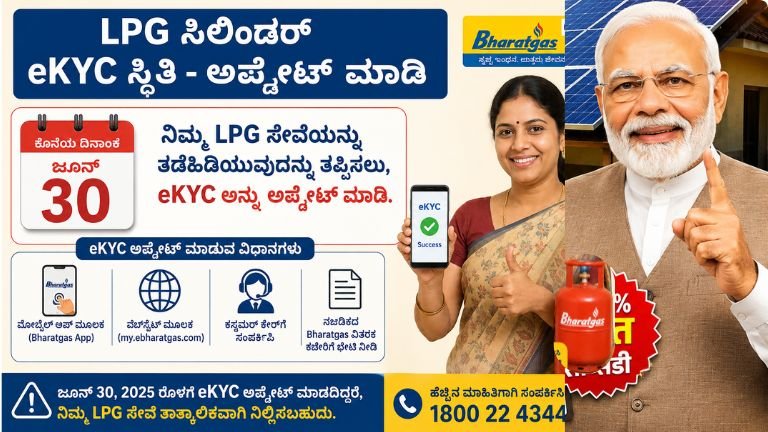
The Ministry of Petroleum and Natural Gas has implemented a rigorous directive requiring all cooking gas consumers—especially those benefiting from targeted subsidies—to complete mandatory Biometric Aadhaar Authentication (BAA).
Distributors across India utilize mobile-based facial recognition apps and fingerprint scanners to complete this verification process.
Critical Compliance Rule (2026): The central government has established strict compliance deadlines for BAA. If a consumer fails to complete their biometric verification by the designated cutoff, their LPG subsidy is placed in abeyance (paused). While refills will still be supplied to prevent domestic kitchen disruptions, the subsidy component is withheld. If authentication is completed after the deadline, the subsidy is restored purely on a prospective basis—meaning all accrued subsidies during the unverified gap period permanently lapse.
The Unified LPG Dashboard
On the back-end, OMCs use advanced Management Information Systems (MIS) and a unified LPG dashboard. Every transaction—from the initial booking via WhatsApp, IVRS, or mobile apps (like Paytm, Amazon Pay, or BHIM) to the exact GPS timestamp of delivery—is tracked. This data loop allows the government to instantly monitor consumption patterns and deploy immediate fiscal adjustments.
Socio-Economic and Environmental Impact
The socio-economic returns of the LPG subsidy program extend far beyond simple energy metrics. It has profoundly altered the rural landscape across multiple dimensions.
Health and Well-being
Traditional biomass cooking methods expose women to toxic indoor smoke, equivalent to burning hundreds of cigarettes an hour in an enclosed space. The World Health Organization (WHO) has historically linked this smoke to chronic obstructive pulmonary disease (COPD), lung cancer, ischemic heart disease, and severe cataracts.
The widespread adoption of subsidized LPG has radically decreased indoor air pollution, resulting in a quantifiable reduction in respiratory illnesses among rural women and an overall drop in infant mortality risks associated with smoky cooking environments.
Time Savings and Gender Equity
The collection of firewood is an exhausting, time-consuming chore. Rural women often trek miles every day, carrying heavy loads on their heads—a practice that inflicts chronic spinal and joint degradation over time.
By switching to a reliable, clean cookstove, women save an average of 2 to 3 hours daily. This newly recovered time can be channeled directly into:
-
Small-scale entrepreneurship (tailoring, livestock, handicrafts).
-
Educational advancement and literacy.
-
Vital childcare and community governance participation.
Macroeconomic and Environmental Benefits
On a macro level, reducing the burning of solid biomass has significantly checked local environmental degradation. It protects forest cover by decreasing the dependency on fresh wood foraging and cuts down black carbon emissions—a potent short-lived climate pollutant. Furthermore, it shifts rural labor from primitive fuel collection to economically productive outputs.
Key Administrative and Structural Challenges
Despite monumental milestones, managing a nationwide subsidy program across a highly populated and geographically diverse country poses ongoing systemic challenges.
The Challenge of “Sustained Refills”
While giving away free or subsidized gas connections ensures initial adoption, ensuring sustained, continuous usage remains an uphill battle. When global energy prices spike, even a subsidized rate can strain a daily wage earner’s tight household budget. In periods of acute economic stress, some rural families temporarily revert to free gathered firewood, treating the gas cylinder as a secondary option for quick meals or rainy days.
Regional Supply Chain Fractures
The logistics of transporting heavy metal cylinders to remote mountain hamlets, forest settlements, and river islands present immense challenges. Infrastructure bottlenecks can cause regional delays, forcing consumers to look to traditional fuels when deliveries fail to arrive on schedule.
High Administrative Overhead Costs
Maintaining the digital infrastructure for over 100 million active subsidy accounts requires substantial fiscal and technological resources. Managing payment gateways, updating biometric records for migrant families, and absorbing multi-billion dollar fuel costs during global crises places a continuous strain on national budget balancing.
Comparative Policy Analysis
The Indian LPG subsidy model stands out globally due to its scale and digital-first delivery architecture. Evaluating it alongside universal and direct-to-retail subsidy structures highlights its operational efficiency.
| Feature / Attribute | Universal Supply-Side Subsidy | India’s Targeted DBTL / PMUY Model |
| Primary Target Base | Open to all citizens regardless of wealth. | Exclusively targeted to low-income/Ujjwala households. |
| Fiscal Diversion Risk | Very High (Diverted to commercial use). | Very Low (Direct to verified individual bank accounts). |
| Market Distortion | High (Suppresses open-market pricing). | Low (Retail price floats at true market rates). |
| Digital Verification | None / Paper-based logs. | Real-time Aadhaar, Biometrics, and digital tracking. |
| Fiscal Sustainability | Unstable (Tied entirely to import bills). | Managed via strict refill quotas (9 per year limit). |
The Future of Clean Cooking Subsidies
As India looks toward its long-term sustainable development goals, the gas cylinder subsidy system is adapting to integrate with broader renewable energy frameworks.
Transitioning to Electric Cooking (E-Cooking)
While LPG is far cleaner than biomass, it remains a fossil fuel. To reduce long-term import dependency, the government is beginning to test solar-assisted electric cooking architectures and energy-efficient induction cooktops in urban and peri-urban locations. Future subsidy structures may gradually shift from supporting gas cylinders to subsidizing clean electricity or solar-powered cooking devices.
Blended Fuel Alternatives
Simultaneously, the Ministry of Petroleum is scaling up investments in Bio-LPG and blending initiatives using compressed biogas (CBG) derived from agricultural waste. This step helps de-link local energy pricing from global market fluctuations, creating a self-sustaining, circular domestic rural economy.
apply now
The gas cylinder subsidy framework in India has evolved from an inefficient, fraud-prone commodity discount into a precise, targeted, digital welfare system. By combining biometric verification through Aadhaar with the direct financial pipelines of PAHAL, the program successfully directs public funds where they are needed most—into the kitchens of poor households.
While balancing global energy price volatility and managing fiscal budgets remains a complex challenge, the social dividends of this system are clear. The expansion of clean cooking gas has improved public health, saved countless hours of labor for millions of women, and established a modern, digital blueprint for large-scale social welfare implementation worldwide.