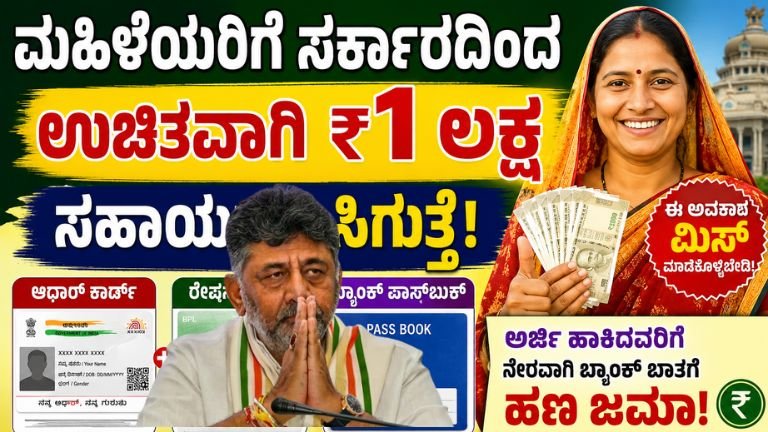
Empowering Women through Direct Subsidies: A Comprehensive Guide to Government Financial Support and Application Protocols
Introduction: The Revolution of Direct Female Financial Empowerment
Universal economic data consistently demonstrates a fundamental developmental truth: when you financially empower a man, you assist an individual; but when you financially empower a woman, you elevate an entire household and community. Across various states and regional administrations, direct benefit transfers (DBT) and high-value financial subsidies have shifted from passive welfare to active tools of economic restructuring.
The announcement of a ₹1 Lakh financial subsidy targeted explicitly at women marks a decisive turning point in public administration. This capital is designed to achieve multiple socio-economic breakthroughs: transforming homemakers into self-reliant micro-entrepreneurs, pulling low-income households out of debt traps, and establishing structural gender equity at the grassroots level. However, as noted in the structural alert, these funds are not distributed casually or automatically. To ensure zero leakage and absolute fiscal responsibility, the administration mandates an aggressive verification framework. Only those women who navigate the formal application channel and furnish ironclad legal documentation will see this capital hit their accounts.
Breaking Down the Procedural Mandate
The message underscores three absolute operational realities that every prospective applicant must internalize before initiating the process:
-
No Automated Windfalls: Governments do not disburse high-value public funds arbitrarily. The system relies entirely on a self-declared, verified application. If a woman fits every single eligibility criterion perfectly but fails to log an official application, her benefit allocation remains precisely zero.
-
The Critical Trio of Documents: The process cannot be completed without three primary documents: the Aadhaar Card (for biometric and unique identity mapping), the Ration Card (BPL/Antyodaya formats for economic tier classification), and the Bank Passbook (for clean financial routing via Direct Benefit Transfer).
-
Targeted Direct Disbursement: Funds are never routed through intermediaries, local leaders, or male family heads. The capital is hard-locked to transfer directly into the applicant’s personal, Aadhaar-seeded bank account to eliminate predatory family dynamics or third-party corruption.
Core Framework of the ₹1 Lakh Subsidy Architecture
When public welfare initiatives or development corporations (such as the State Women’s Development Corporations) structure a financial program of this magnitude, the disbursement generally falls into one of two strategic formats depending on the specific policy architecture:
Model A: The Self-Employment Micro-Enterprise Grant (e.g., Udyogini & Allied Subsidies)
Under this operational framework, the ₹1 Lakh benefit operates as a high-subsidized capital deployment engine. The government provides or facilitates financial assistance up to ₹1 Lakh to ₹3 Lakh to help women set up local businesses (such as tailoring units, grocery shops, eco-friendly manufacturing, or cottage industries). The crucial element here is the subsidy component, which frequently scales from 30% to 50%. For instance, in a ₹1 Lakh project structure, up to ₹50,000 is written off as a completely free government grant, leaving the remaining portion as an interest-free or highly concessionary loan.
Model B: Generational Social Security Maturation (e.g., Bhagyalakshmi and Maturation Schemes)
In alternative social security designs targeting economically weaker sections, the state locks high-value deposits in the name of the female beneficiary. Upon fulfilling core milestones—such as completing formal high-school education, maintaining a clean legal status, and reaching maturity (18 years of age)—the fund matures into a direct financial payout of ₹1 Lakh or more, providing vital capital for higher education or independent enterprise.
Detailed Breakdown of the Three Mandatory Pillars of Verification
The success of your application hinges entirely on the alignment of three core documents. Any discrepancy across these three elements will result in an immediate system rejection during digital desk scrutiny.
+-------------------------------------------------------------------------+
|                  THE CORE TRINITY OF APPLICATION VERIFICATION           |
+------------------+------------------------------------------------------+
| Document Type    | Vital System Function                                |
+------------------+------------------------------------------------------+
| Aadhaar Card     | Unique Identity, Biometric Lock, and NPCI Seeding    |
| Ration Card      | Economic Eligibility Proof (BPL/AAY Status Validation) |
| Bank Passbook    | DBT Routing Destination (Must match Aadhaar Name)   |
+------------------+------------------------------------------------------+
I. The Aadhaar Card: The Biometric Anchor
Your Aadhaar card serves as your unique digital fingerprint within the state infrastructure.
-
The Matching Rule: The name spelling on your Aadhaar card must perfectly mirror the records held in your state civil databases.
-
Mobile Linking: Your active, current mobile phone number must be linked to your Aadhaar card. The registration portals rely heavily on secure Aadhaar-based Time-based One-Time Passwords (TOTP) to validate authentic submissions.
-
NPCI Seeding: The Aadhaar must be actively linked to your bank account via the National Payments Corporation of India (NPCI) gateway. Without this, the automated direct benefit transfer system cannot clear the payment file.
II. The Ration Card: The Economic Filter
Because this program is structurally designed to support the poor and struggling middle-class segments, the Ration Card acts as the primary tool to filter out affluent applicants.
-
Card Classification: Typically, preference or absolute eligibility is restricted to holders of Below Poverty Line (BPL) cards, Priority Household (PHH) cards, or Antyodaya Anna Yojana (AAY) cards.
-
Family Head Mapping: In line with major regional welfare initiatives, the applicant must explicitly be listed either as the female head of the household on the ration card or as a primary adult female member of that specific domestic unit.
III. The Bank Passbook: The Financial Gateway
The Bank Passbook is not merely structural proof that you hold an account; it is the physical layout containing your data destination coordinates.
-
Core Legibility: The scanned copy or physical photocopy submitted must clearly display the Account Number, the Bank Branch Name, and the specific IFSC Code.
-
Account Status: The account must be a fully operational, individual savings bank account (not a corporate account or a frozen dormant account). It must have its Know Your Customer (KYC) details fully refreshed with the parent bank to prevent large inflows of capital from bouncing.
Step-by-Step Step-by-Step Walkthrough of the Application Process
To guarantee your entry into the scheme without falling prey to administrative bottlenecks, follow this definitive procedure:
The Application Sequence
WARNING ON DEADLINES: Mass financial schemes operate on fixed fiscal budget allocations. The processing queues are organized based on the timestamp of submission. Delays in uploading your documents could push your application into the next fiscal year’s pool or cause you to miss the allocation cut-off entirely.
The Multi-Layered Inspection and Anti-Fraud System
To maintain absolute transparency and shield public money from corruption, your application undergoes rigorous backend processing before a single rupee is disbursed.
-
Automated Income Tax Scrutiny: The system cross-references the PAN and Aadhaar of the applicant and her spouse against direct tax databases. If the household is found to be paying Income Tax or earning an income that exceeds the low-to-middle class thresholds, the application is automatically purged.
-
Government Employee Filtering: If the applicant or her immediate family member holds a permanent position within a state government unit, central government entity, or public sector undertaking (PSU), they are structurally excluded from receiving this specific welfare benefit.
-
Physical Ground Geotagging: For schemes linked to setting up local businesses or micro-enterprises, local Child Development Project Officers (CDPO) or Gram Panchayat officials will conduct brief field spot-checks to verify the physical location and authenticity of the applicant’s domestic or commercial setup.
The Deep Economic Impact of Female-Led Financial Subsidies
The Multiplier Effect on Household Wealth
When money flows directly to a female head of household, spending patterns alter dramatically compared to general cash injections. Empirical field research confirms that women divert over 90% of their financial resources straight back into core family development:
-
Nutritional Equity: Direct investment in higher-quality food, significantly lowering childhood malnutrition rates within the community.
-
Educational Continuity: Securing school fees, books, and digital learning tools for young girls and boys, dramatically reducing drop-out rates.
-
Healthcare Resilience: Creating a financial cushion that prevents families from sliding back into severe poverty due to sudden, unexpected medical emergencies.
Ignition of Local Micro-Capitalism
A ₹1 Lakh subsidy functions as an initial capital ignition source. When ten women in a single village receive this funding and establish small enterprises, they build a localized micro-economy. They stop buying inventory from distant urban centers and start trading with one another, keeping wealth circulating inside the rural ecosystem. This reduces forced migration to overcrowded cities and builds structural self-reliance at the village level.CCommon Bottlenecks and How to Resolve Them
Issue A: “Aadhaar Not Seeded with Bank Account”
-
The Cause: Even if your bank account is active, it might not be linked to the centralized clearinghouse via the National Payments Corporation of India (NPCI) mapper for direct benefits.
-
The Solution: Do not try to solve this online. Walk physically into your bank branch, request an “Aadhaar DBT Seeding Form,” fill it out, and submit it directly to the branch manager. Request them to update your status on the central portal within 48 hours.
Issue B: “Biometric Failure During E-KYC”
-
The Cause: For older women or those engaged in manual labor, fingerprint ridges can wear down, leading to repeated verification errors at local citizen service desks.
-
The Solution: Switch the verification protocol on the portal from fingerprint scanning to Iris Scanning (eye validation) or request an Aadhaar OTP-based validation sent to the registered mobile phone number.
Issue C: “Dormant Account Rejections”
-
The Cause: If a savings account has seen zero transactions for more than six consecutive months, banks automatically flag it as “Dormant” for security reasons, causing government direct transfers to fail.
-
The Solution: Visit your bank, deposit a nominal amount (such as ₹100 or ₹200) manually, execute a minor withdrawal, and submit a fresh self-declaration form to reactivate the account completely.
9. Comprehensive Eligibility & Document Checklist
Before walking to your nearest citizen service center or launching your online application, review this final master checklist to confirm that your profile is completely bulletproof.
| Eligibility Parametric | Acceptable Validations | Action Item Status |
| Gender Status | Must be biologically female and a permanent resident of the state. | [ ] Confirmed |
| Age Range | Typically between 18 and 55 years of age at submission time. | [ ] Confirmed |
| Economic Stratum | Household income must be below the declared threshold (typically under ₹1.5 to ₹2 Lakh annually). | [ ] Confirmed |
| Identity Anchoring | Physical Aadhaar details must be fully up-to-date with your current address. | [ ] Confirmed |
| Financial Routing | Active individual bank account linked to your unique Aadhaar number via NPCI. | [ ] Confirmed |
| Dependency Status | Must possess a valid, updated BPL or Priority Household Ration Card. | [ ] Confirmed |
Mobilize Your Application Today
Public empowerment initiatives of this scale represent a rare and powerful financial vehicle to help families break free from economic stagnation. However, because these programs are backed by rigorous digital accountability measures, they demand absolute administrative compliance from the applicant.
Do not treat this announcement lightly or leave the application process for the final week. Gather your Aadhaar Card, verify your Ration Card details, ensure your Bank Passbook is completely legible, and initiate your application immediately. By securing your official acknowledgment receipt today, you take definitive, legal control of your financial destiny, laying down a foundation of security, dignity, and long-term prosperity for yourself and your entire household.